Helping you navigate insurance for your EV
With EVs continuing to gain interest as a share of new and used cars in Australia, buying insurance shouldn't be an expensive and confusing hassle.
You generally won't need special insurance for your EV, but there are a few considerations for EV owners when shopping around for insurance.
Frequently Asked Questions
According to The Driven, the most popular EVs sold in Australia in 2024 were the Tesla Model Y and the Model 3. The MG MG4 has pulled ahead of the BYD Atto and Seal for third place.
Generally no, but there are a few things to consider. At this time, there are no tailored insurance policies specifically for EVs in Australia offered by the mainstream car insurers.
There are lots of reasons given by the insurance industry about why insurance premiums for EVs are typically higher than petrol cars. However many of these reasons are not unique to EVs, including the higher purchase costs, escalating repair costs and the need to import specialised parts.
In general, insurers are typically more conservative about insuring newer products because the loss data that they base their pricing on is not as robust. This is evident in the very wide range of quotes that you will receive for your EV from different insurers.
It is true that repairing EVs requires additional training for mechanics, given the risks around working with batteries. In addition, there is some evidence that battery electric vehicles are more likely to be written off in an accident, due to potential damage to batteries.
Insurance Council of Australia's submission to the National Electric Vehicle Strategy recommends that the Government invest in skills training to address the shortage of skilled technicians.
Insurers request a lot of personal information about you and other drivers on your policy that they run through their proprietary pricing models. This includes your age, gender, driving record, garaging, extent and type of use (business or personal) and often other factors.
A major factor tends to be your post code. Generally, inner city locations and affluent suburbs tend to have higher premiums, and some insurers do not even provide insurance in certain post codes. A younger driver (under 40) boosts your premium significantly; having finance on the vehicle generally leads to a higher premium because there is a third party involved that may need to be paid out on a claim. Factors such as prior claims or licence suspensions will have predictably large negative impacts on your premiums.
A few years ago, many mainstream insurers would not provide insurance for Teslas and other EVs, but now many do. An insurer's willingness to provide cover for a particular car in a particular location can change without notice, and the only way to find out is to attempt to get an online quote or call the company.
Pay-as-you-drive is a new type of car insurance using what's called 'telematics'. These products typically require you to install a special sensor in your car to detect how much you drive. They then charge premiums based on your actual usage. The assumption is that if you drive less you will have fewer accidents. If you don't use your car very much, these policies may be cheaper for you.
Telematics insurance policies are growing in use overseas, but are not widely available in Australia and there do not currently appear to be any that insure EVs.
In the United States, Tesla offers insurance in certain states using a form of telematics that prices your premiums based on your driving style. Tesla calculates a driver safety score based on your driving behaviour, which is calculated and updated in the app. You can view your safety score and how it influences your insurance premium. This product is not available in Australia.
Insurance Landscape
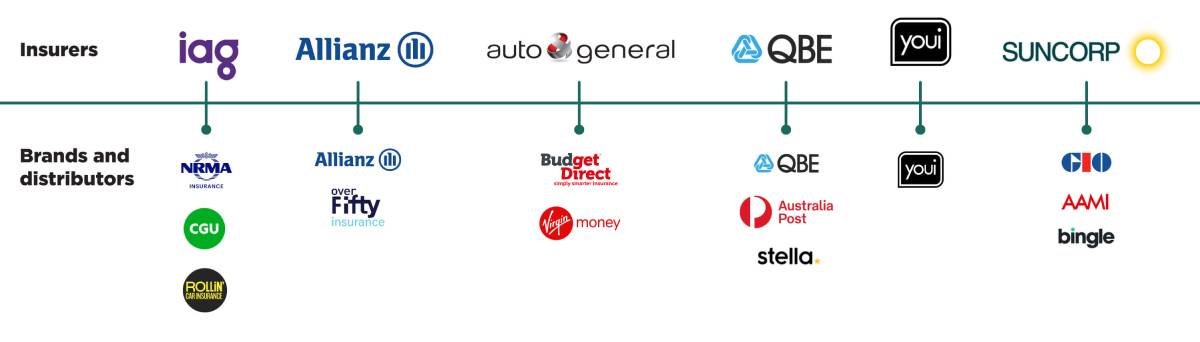
Insurers generally distribute their insurance policies through different brands and distribution channels. The brand you recognise is generally the distributor. There are only a small number of insurers and they tend to have similar pricing even through diferent brands.
So it's good to know which insurer you are dealing with as you'll very likely be quoted the same premium.
The car insurance industry at a glance